White-winged Scoter
Melanitta delgandi
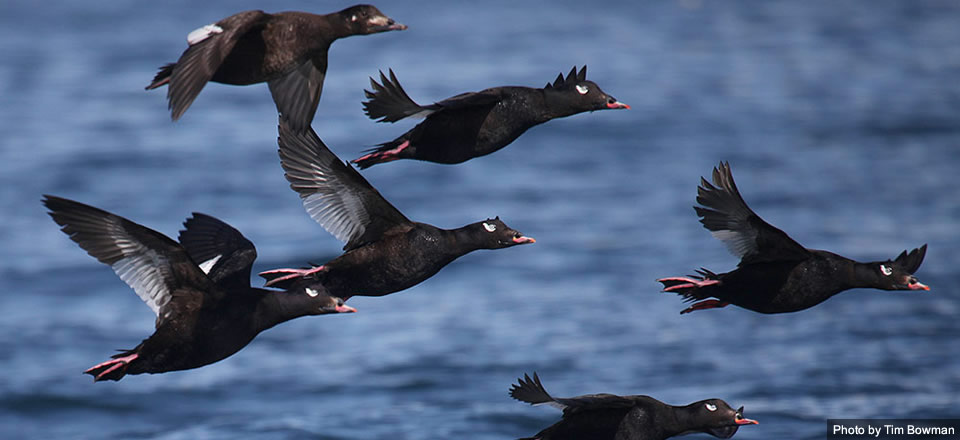
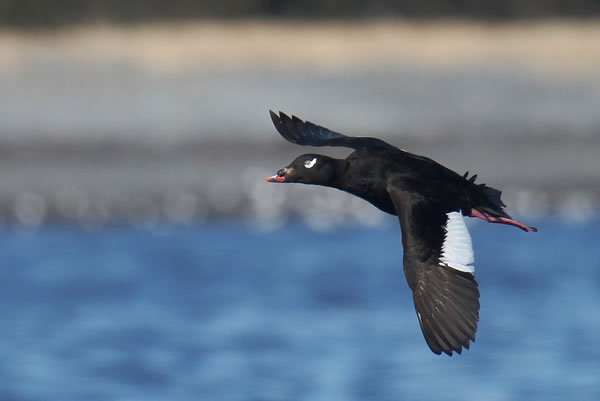
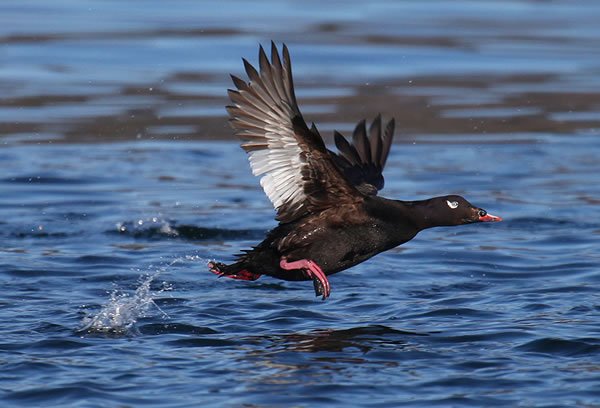
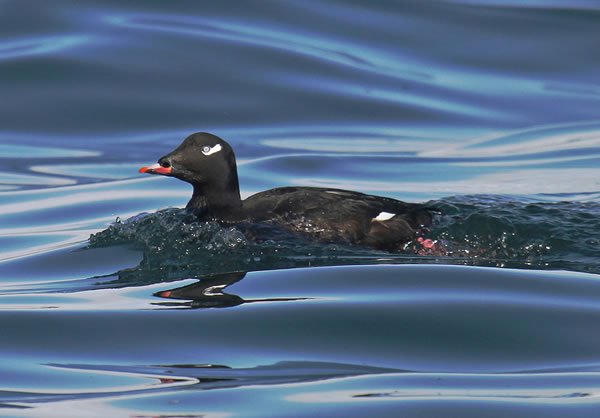
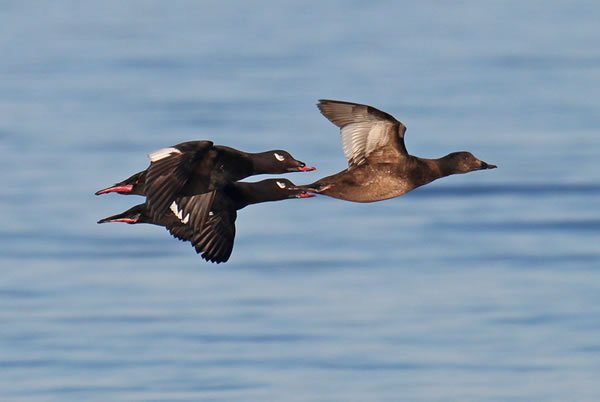
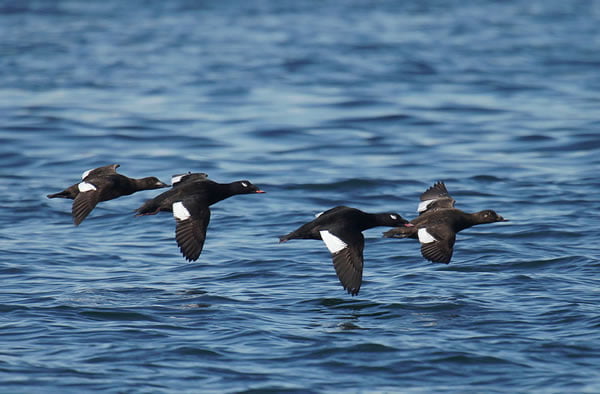
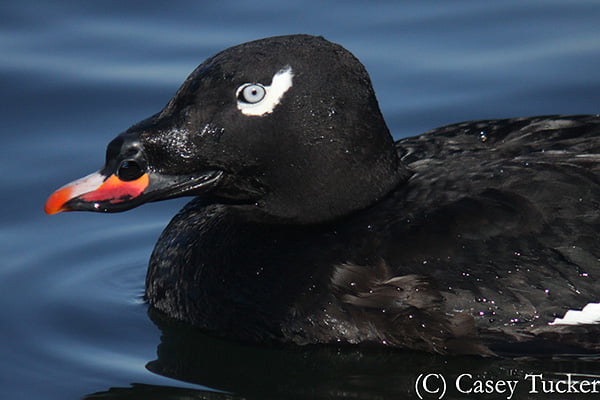
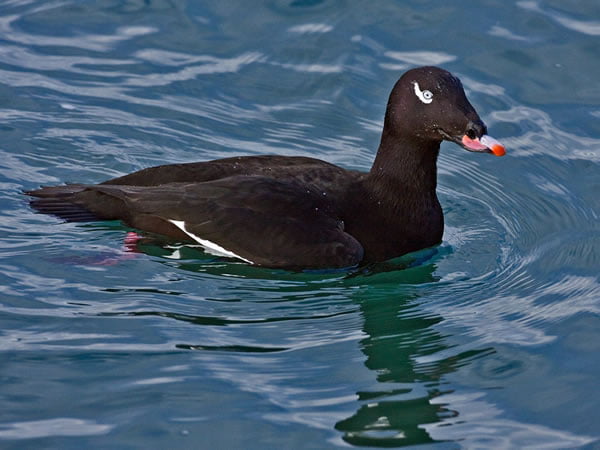
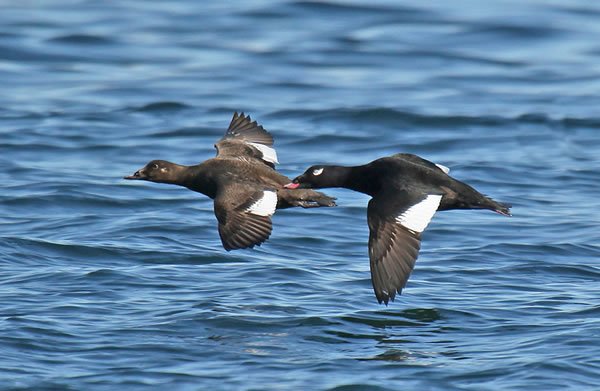
The white-winged scoter is the largest of the three scoters. Adult males are 53–58 cm (21– 23 in.) long and weigh 1,360–1,780 grams (3–4 lbs); adult females are slightly smaller. They are distinguished from other scoters by the all-white patch (speculum) on the secondary feathers of their wings, which is obvious in flight and sometimes visible at rest. Adult males are entirely blackish with a small white, teardrop-shaped patch around its eye. Its orange bill has a black hump at the base and is somewhat wedge-shaped. Females and juveniles of both sexes are dark brownish with paler bellies; females and juveniles have a dark bill and variable amounts of white on their head that can appear as spots.
Sea Duck Information Series fact sheet [PDF]
White-winged Scoter Species Knowledge Summary and Information Needs [PDF]
White-winged Scoter Tracking Data
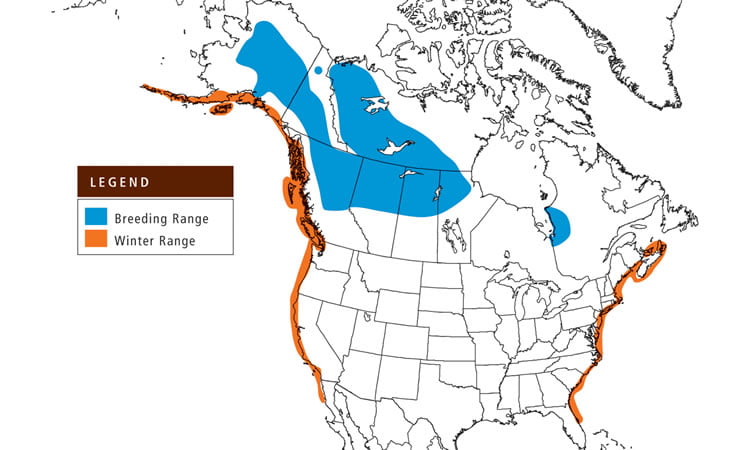
The Sea Duck Joint Venture has invested in numerous projects employing satellite and radio tracking devices to address pressing management-related questions. These data have enabled researchers to discover migratory pathways, delineate populations, and describe habitat use and behavior. This catalog includes existing tracking datasets for White-winged Scoters.
[invisible]
SDJV Project 166 — Advancing Trans-boundary Sea Duck Conservation Actions: Scoter Habitat Use and Movement Patterns in the Salish Sea
Project Summary: 33 White-winged Scoters in the Salish Sea were surgically implanted with Ornitela GPS-GSM transmitters beginning in 2021. This project is led by Washington Department of Fish and Wildlife (WDFW) andCanadian Wildlife Service (CWS). Capture locations included both British Columbia and Washington (Bellingham Bay and Drayton Harbor).
Tracking Data: Metadata and contact information are available in Movebank (ID 2475804252 for WDFW data and ID 2017291177 for CWS data).
Related Publications: Visit the SDJV Project 166 webpage for interim and final reports.
SDJV Project 130 — Atlantic and Great Lakes Sea Duck Migration Study
Project Summary: This large-scale satellite telemetry study aimed to fully describe the annual migration patterns for four species of sea ducks (Surf Scoters, Black Scoters, White-winged Scoters, and Long-tailed Ducks) in the Atlantic and Great Lake Flyways. As part of this project, Sea Duck Joint Venture partners implanted 105 White-winged Scoters with internal satellite transmitters between 2009 and 2014. The organizations included Environment and Climate Change Canada, Biodiversity Research Institute, Rhode Island Department of Environmental Management, University of Rhode Island, and Long Point Waterfowl. Capture locations included Massachusetts, Maine, New York, Ontario, Québec, and Rhode Island.
Tracking Data: More information coming soon.
Related Publications: Visit the SDJV Project 130 and Project 155 webpages for reports and publications.
SDJV Project 28 — Determination of Breeding Areas, Migration Routes, And Local Movements Associated with Surf and White-Winged Scoters Wintering in the Inner Marine Waters of Washington State
Project Summary: This project used implanted satellite and radio transmitters to better understand the demography and movements of Surf and White-winged Scoters in Washington state waters. It was led by the Washington Department of Fish and Wildlife, with the U.S. Geological Survey and the University of Washington also collaborating. The research team implanted 26 White-winged Scoters with PTT satellite transmitters (Microwave and Telonics) in 2003. Capture locations were in the Washington portion of the Salish Sea.
Tracking Data: Metadata and contact information are available in Movebank (ID 949577211).
Related Publications: Visit the SDJV Project 28 webpage for reports and publications.
EVOS Restoration Project 273 — Seasonal Movements of White-Winged Scoters from Prince William Sound, Alaska
Project Summary: This report is for a restoration project related to the Exxon Valdez Oil Spill (EVOS). The project used satellite telemetry to track the movements of white-winged scoters wintering in the Gulf of Alaska to determine timing and routes of migration and affiliations among wintering, breeding, and molting areas. This was the first successful satellite telemetry project to monitor the movements of White-winged Scoters. Researchers captured 13 females and 9 males in Prince William Sound, Alaska, in 1999 and 2000 and implanted them with satellite transmitters. The work was led by Daniel Rosenberg of the Alaska Department of Fish and Game (ADF&G).
Tracking Data: All data is archived at ADF&G regional headquarters in Anchorage.
Related Publications: Read the EVOS Restoration Project 273 final report to learn more.
White-winged Scoter Photo Gallery
White-winged Scoter Range Map