Steller’s Eider
Polysticta stelleri
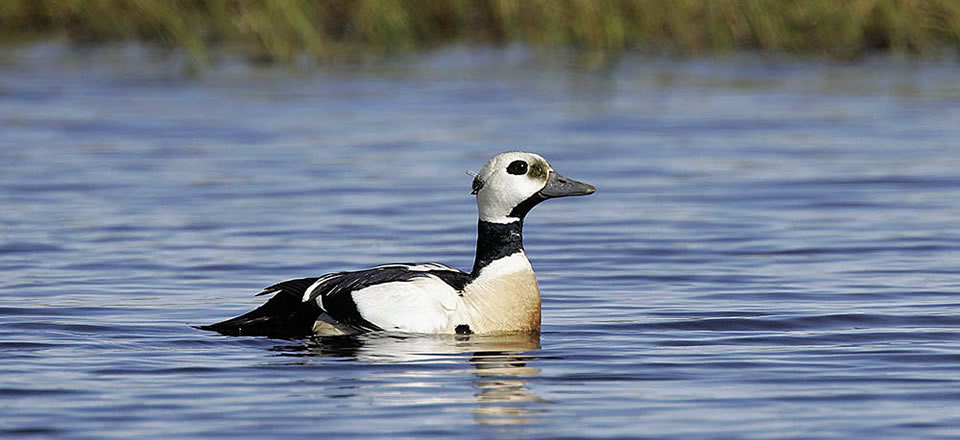
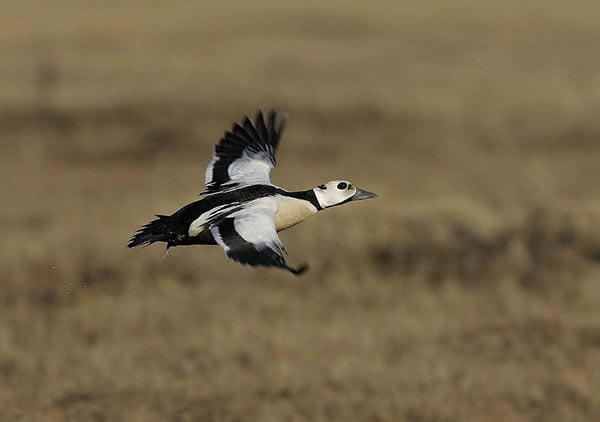
Steller’s Eiders are the smallest of the four eider species, averaging 43-47 cm (17-18.5 in.) with average body mass of about 850g (female) or 880g (male) (about 2 lbs.). Adults of both sexes have a blue patch with a white border on the upper wing, similar to a Mallard.
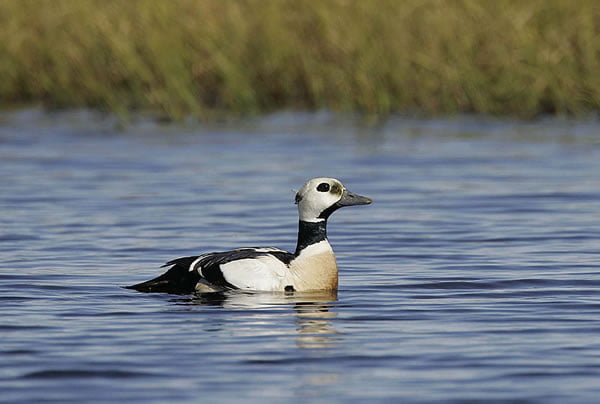
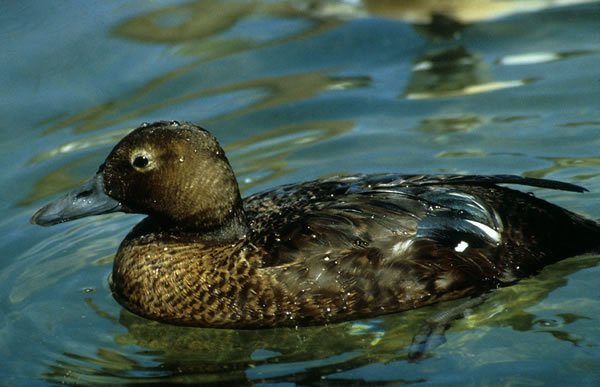
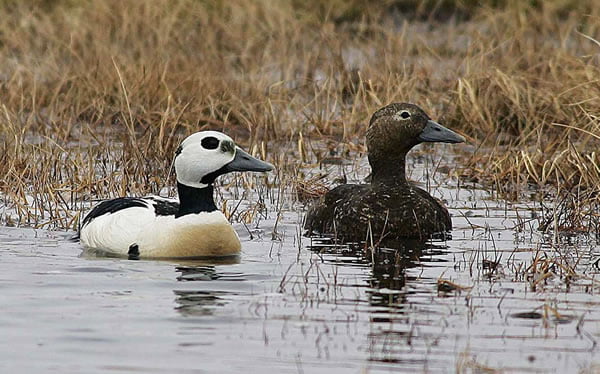
In winter, spring, and early summer adult males are in breeding plumage with a black back, white shoulders, chestnut breast and belly, a white head with a greenish tuft, and small black eye patches. During the late summer and fall, males have mottled dark brown body plumage but retain the white wing bar. Females and juveniles are mottled dark brown year-round.
Sea Duck Information Series fact sheet
Steller’s Eider Species Knowledge Summary and Information Needs [PDF]
Steller’s Eider Tracking Data
The Sea Duck Joint Venture has invested in numerous projects employing satellite and radio tracking devices to address pressing management-related questions. These data have enabled researchers to discover migratory pathways, delineate populations, and describe habitat use and behavior. This catalog includes existing tracking datasets for Steller’s Eiders collected by partners in the U.S. Fish and Wildlife Service, U.S. Geological Survey, and Alaska Department of Fish and Game.
[invisible]
Seasonal Movements and Distribution of Pacific Steller’s Eiders
Project Summary: This satellite telemetry study aimed to characterize the annual movements and habitat use of Pacific Steller’s eiders wintering at Kodiak Island, Alaska. The research team captured 24 birds between 2004–2006 and implanted them with internal satellite transmitters. This study was led by the Alaska Department of Fish and Game (ADF&G) Division of Wildlife Conservation.
Tracking Data: All data is archived at ADF&G regional headquarters in Anchorage.
Related Publications: Additional information is available in ADF&G Division of Wildlife Conservation Wildlife Research Report 2016–7.
Rosenberg, D. H., M. J. Petrula, J. L. Schamber, D. Zwiefelhofer, T. E. Hollmen, and D. D. Hill. 2014. Seasonal Movements and Distribution of Steller’s Eiders Wintering at Kodiak Island, Alaska. Arctic 67:347–359.
Breeding and Moulting Locations and Migration Patterns of the Atlantic Population of Steller's Eiders Polysticta Stelleri as Determined From Satellite Telemetry
Project Summary: This study tracked Steller’s Eiders in northern Europe and northwest Russia between 2001 and 2002. 20 Microwave internal PTT transmitters were deployed, with all capture locations in Vadso, Norway. The objectives were to provide additional information on the distribution, migration routes, and timing of migration of the Atlantic population of Steller’s Eider. This project was funded by the U.S. Geological Survey Alaska Science Center and the Norwegian Directorate for Nature Management.
Tracking Data: Datasets are available in Movebank (ID 1481243).
Related Publications: Petersen, M.R., J.O. Bustnes, and G.H. Systad. 2006. Breeding and moulting locations and migration patterns of the Atlantic population of Steller’s eiders Polysticta stelleri as determined from satellite telemetry. Journal of Avian Biology 37(1):58–68. doi.org/10.1111/j.0908-8857.2006.03472.x
Distribution and Movements of Alaska-breeding Steller’s Eiders in the Non-breeding Period
Project Summary: This study aimed to understand the timing of use and distribution of autumn migration routes, stopover sites, and molting and wintering areas by the Alaska-breeding population of Steller’s Eiders. The research team implanted 14 Steller’s Eiders with Microwave PTT satellite transmitters in 2000 and 2001 at their primary breeding grounds near Utqiagvik (Barrow), Alaska. Collaborating organizations include the U.S. Fish and Wildlife Service, U.S. Army Corps of Engineers, and U.S. Air Force.
Tracking Data: The USGS Alaska Science Center has released tracking data for Steller’s Eiders at doi.org/10.5066/P9ECETBG. Datasets are also available in Movebank (ID 1996478990).
Related Publications: Martin, P.D., D.C. Douglas, T. Obritschkewitsch, and S. Torrence. 2015. Distribution and movements of Alaska-breeding Steller’s Eiders in the non-breeding period. The Condor: Ornithological Applications 117(3): 341–353. doi:10.1650/CONDOR-14-165.1
Steller’s Eider Photo Gallery

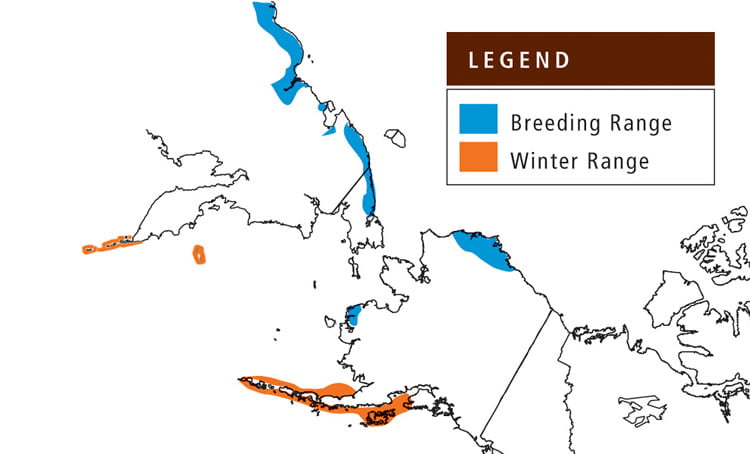
Steller’s Eider Range Map