Spectacled Eider
Somateria fischeri
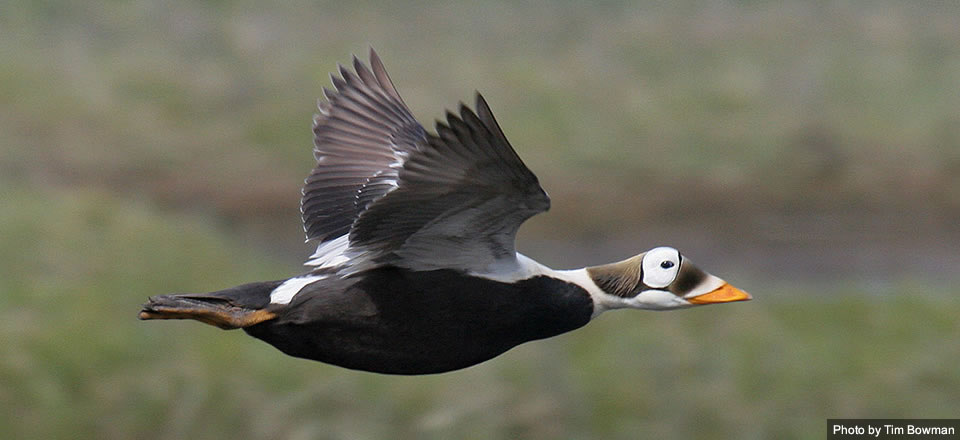
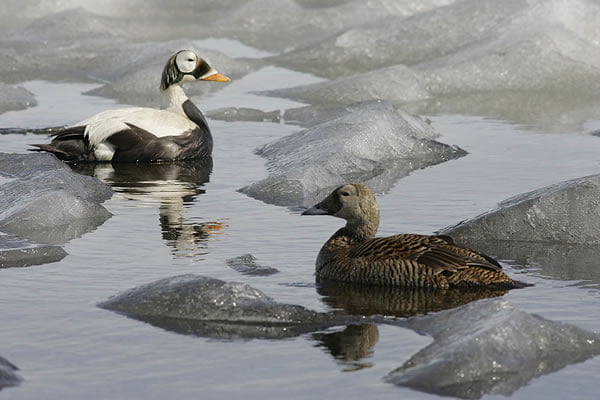
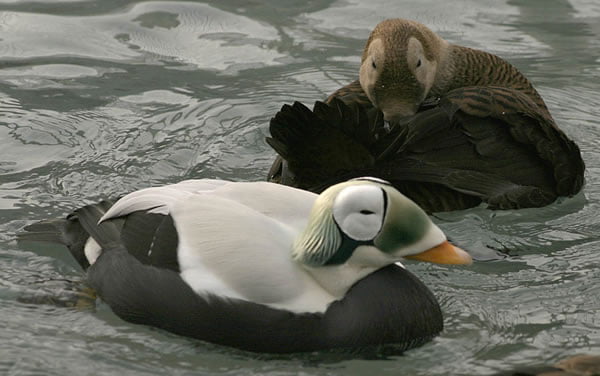
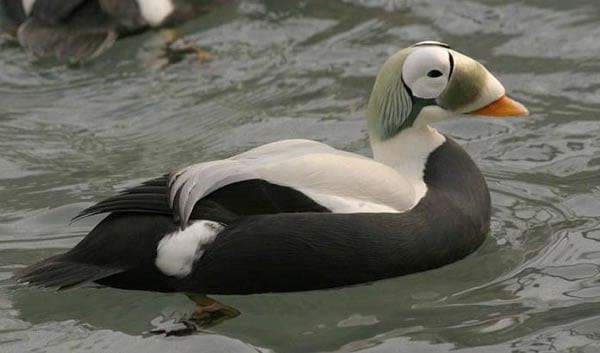
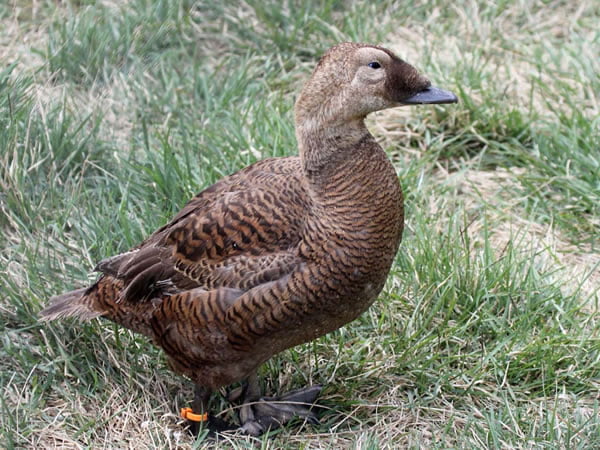
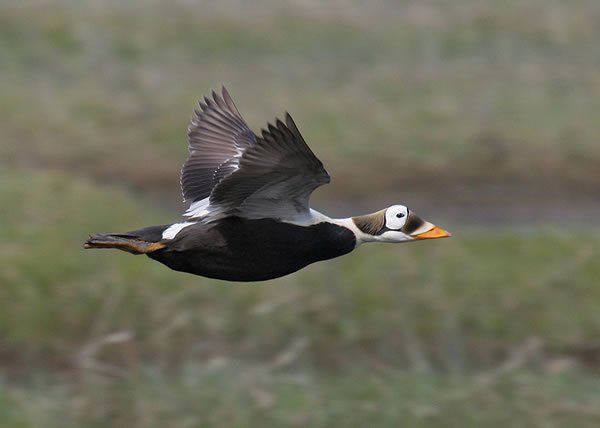
Spectacled eiders are large sea ducks, 52-56 cm (20-22 in.). Males weigh about 1500 g and females 1600 g (about 3.4 lbs.) in spring before nesting, after which males outweigh females.
Sea Duck Information Series fact sheet [PDF]
Spectacled Eider Species Knowledge Summary and Information Needs [PDF]
Spectacled Eider Tracking Data
The Sea Duck Joint Venture has invested in numerous projects employing satellite and radio tracking devices to address pressing management-related questions. These data have enabled researchers to discover migratory pathways, delineate populations, and describe habitat use and behavior. This catalog includes existing tracking datasets for Spectacled Eiders collected by partners at the U.S. Fish and Wildlife Service and U.S. Geological Survey.
[invisible]
U.S. Fish and Wildlife Service – Tracking Data for Spectacled Eiders
Project Summary: 119 Microwave PTT telemetry devices were implanted in Spectacled Eiders breeding in Alaska. Deployments in 2018 were at two sites on the Yukon-Kuskokwim Delta: Kigigak Island and the Tutakoke River. Deployments in 2022 were at the Tutakoke River on the YKD and on the Arctic Coastal Plain at Utqiagvik and Teshekpuk Lake. This study was a collaboration between the U.S. Fish and Wildlife Service (Yukon Delta National Wildlife Refuge and Fairbanks Field Office Ecological Services), the University of Alaska Fairbanks, and the Bureau of Land Management. Additional support from the USGS Alaska Science Center and the villages of Newtok, Chevak, and Utqiagvik.
Tracking Data: Project metadata and contacts are available in Movebank (ID 1001363284).
Related Publications: The latest status assessments and ESA listing decisions can be found here: Species Profile for Spectacled eider (Somateria fischeri).
U.S. Geological Survey Data Release – Tracking Data for Spectacled Eiders
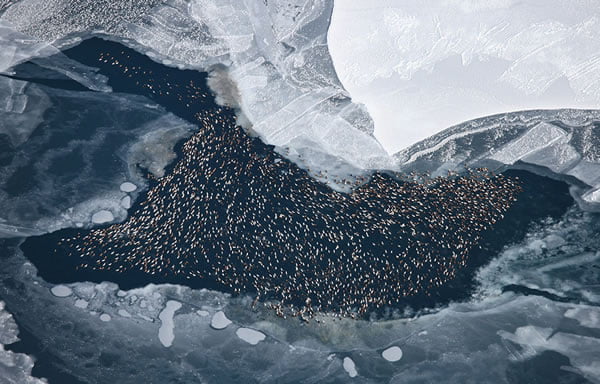
Project Summary: 208 spectacled eiders were surgically implanted with Microwave PTT satellite transmitters between 1993–2011 in northern and western Alaska. Capture locations included the North Slope and the Yukon-Kuskokwim Delta. These data were collected to better understand the winter distribution in the Bering Sea and locate birds for winter aerial surveys to track population trends over time.
Tracking Data: The USGS Alaska Science Center has released tracking data for Spectacled Eiders at doi.org/10.5066/P9B091HG.
Related Publications:
The latest status assessments and ESA listing decisions can be found here: Species Profile for Spectacled eider (Somateria fischeri).
Petersen, M. R., D. C. Douglas, and D. M. Mulcahy. 1995. Use of Implanted Satellite Transmitters to Locate Spectacled Eiders at-Sea. The Condor 97:276–278. https://www.jstor.org/stable/1369006
Petersen, M. R., W. W. Larned, and D. C. Douglas. 1999. At-Sea Distribution of Spectacled Eiders: a 120-Year-Old Mystery Resolved. The Auk 116:1009–1020.
Petersen, M. R., and D. C. Douglas. 2004. Winter Ecology of Spectacled Eiders: Environmental Characteristics and Population Change. The Condor 106:79. 10.1650/7292
Sexson, M. G., M. R. Petersen, G. A. Breed, and A. N. Powell. 2016. Shifts in the distribution of molting Spectacled Eiders indicate ecosystem change in the Arctic. The Condor 118:463–476.http://dx.doi.org/10.1650/CONDOR-15-139.1
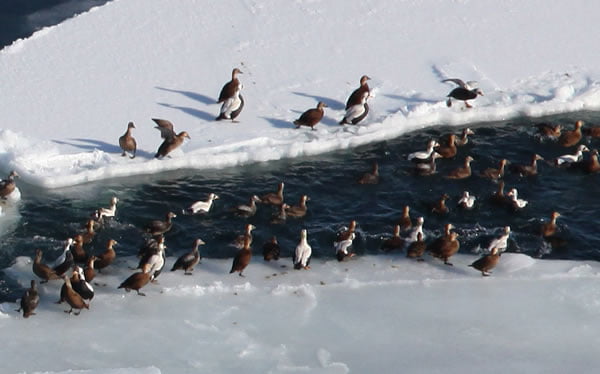
Spectacled Eider Photo Gallery
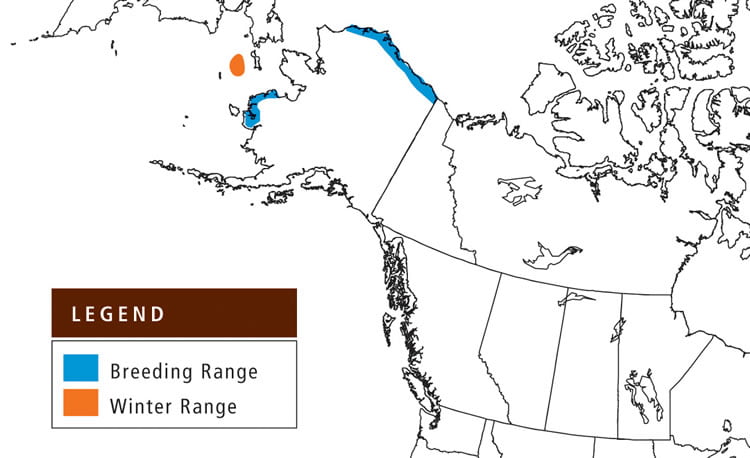
Spectacled Eider Range Map