King Eider
Somateria spectabilis
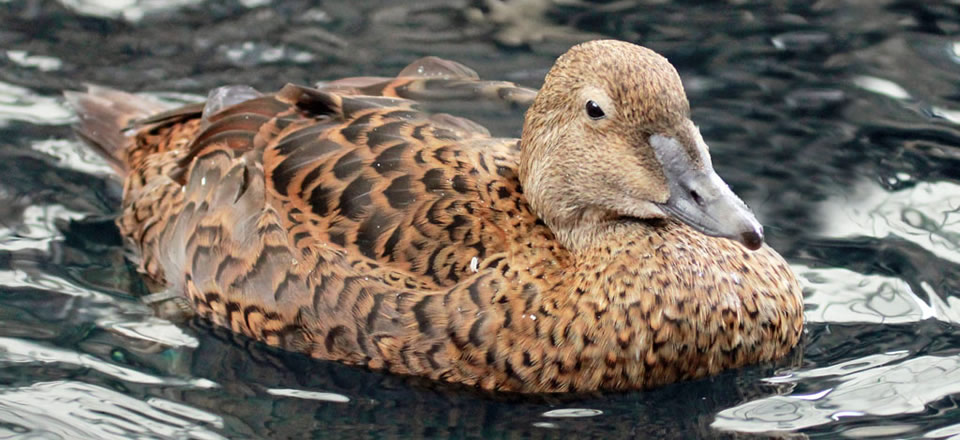
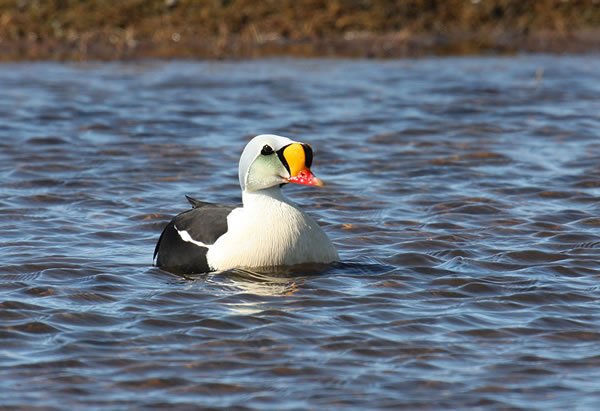
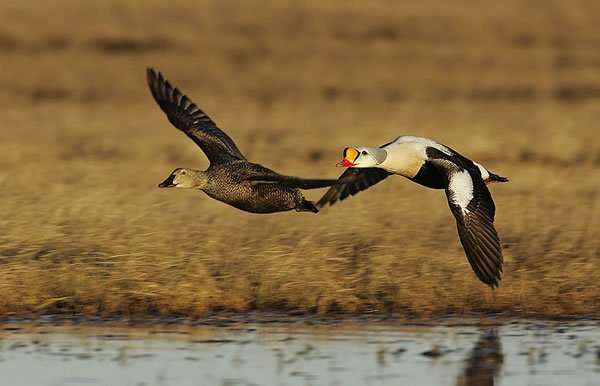
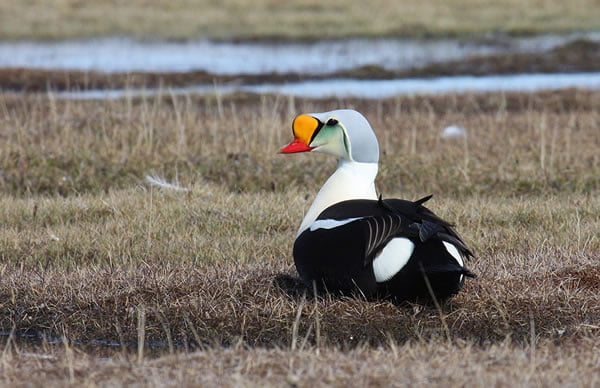
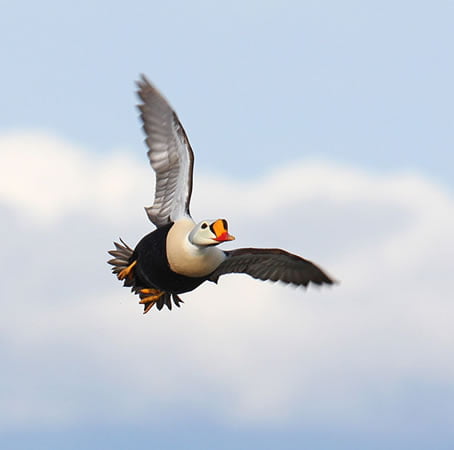
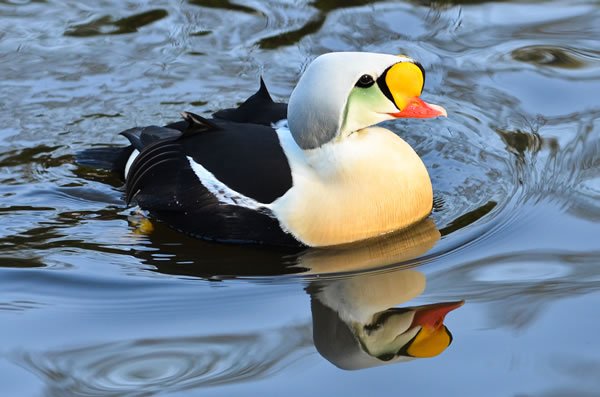
King eiders are a moderately large sea duck, weighing 1200-2100 g (2.6 – 4.6 lbs). Male king eiders are one of the most ornately plumaged ducks in North America. In breeding plumage (late fall through midsummer), males sport a large orangeyellow knob between their bill and forehead. Their forehead, crown, and nape is pearl blue, with iridescent pale green cheeks and a reddishorange bill. The lower portion of their head, neck, upper back, and breast is white with the remainder of the body black. The longest feathers along their upper flanks have triangular extensions that form a sail-like projection on their back.
Sea Duck Information Series fact sheet
King Eider Species Knowledge Summary and Information Needs [PDF]
King Eider Tracking Data
The Sea Duck Joint Venture has invested in numerous projects employing satellite and radio tracking devices to address pressing management-related questions. These data have enabled researchers to discover migratory pathways, delineate populations, and describe habitat use and behavior. This catalog includes existing tracking datasets for King Eiders.
[invisible]
SDJV Project 25 — Breeding Biology and Habitat Use of King Eiders on the Coastal Plain of Northern Alaska
Project Summary: This project aimed to describe the spatio-temporal distribution of pre-breeding individuals and adult female eiders that had been successful breeders, study natal philopatry, and examine fidelity to wing moulting and wintering areas The research team implanted 80 King Eiders with Argos satellite transmitters between 2006 and 2009. The project was led by the University of Alaska Fairbanks in partnership with the North Slope Borough. All birds were captured and tagged on the North Slope of Alaska.
Tracking Data: Data are available in Movebank (ID 213511247) at doi.org/10.5441/001/1.339.
Related Publications: Visit the SDJV Project 25 webpage for reports and publications.
SDJV Project 24 — Importance of the Alaskan Beaufort Sea to King Eiders
Project Summary: This study was designed to better understand use (timing, location, duration) of nearshore and offshore habitats of the Beaufort Sea to migrating, staging, and molting adult King Eiders using satellite telemetry. Between 2002 and 2004, researchers surgically implanted 60 King Eiders with internal PTT transmitters. All capture locations were on the Arctic Coastal Plain of Alaska. The University of Alaska Fairbanks led this project in collaboration with the U.S. Fish and Wildlife Service, the Coastal Marine Institute, North Slope Borough, and ConocoPhillips.
Tracking Data: Data are available in Movebank (ID 213511247) at doi.org/10.5441/001/1.339.
Related Publications: Visit the SDJV Project 24 webpage for reports and publications.
SDJV Project 6 — Identifying Migration Routes and Wintering Areas of Common and King Eiders Breeding in Nunavut, Canada and Greenland
Project Summary: This satellite telemetry project aimed to identify King Eider and Common Eider breeding populations in Canada and Greenland that migrate to winter in southwest Greenland. 36 satellite transmitters were surgically implanted in King Eiders between 1999 and 2003. This project was led by the Canadian Wildlife Service, with the Greenland Institute of Natural Resources and the National Environmental Research Institute of Denmark also participating. Capture locations included northeast Canada (10 eiders) and western Greenland (26 eiders).
Tracking Data: Datasets are available in Movebank (ID 43747715).
Related Publications: Visit the SDJV Project 6 webpage for reports and publications.
SDJV Project 2 — Identification of Beaufort Sea Migration Corridor for Sea Ducks
Project Summary: This study used satellite telemetry to study migration corridors for Common Eiders, King Eiders, and Long-tailed Ducks so that analysts could predict and mitigate adverse effects of offshore oil development in the Beaufort Sea. In 2008, 29 King Eiders were captured using mist nets on ponds on Banks Island, a breeding area in the Northwest Territories. Researchers from the Canadian Wildlife Service and the U.S. Fish and Wildlife Service surgically implanted them with Microwave PTT satellite transmitters.
Tracking Data: More information coming soon.
Related Publications: Visit the SDJV Project 2 webpage for reports and publications.
Contact: Information coming soon.
East Bay Island Migratory Bird Research
Project Summary: A research team deployed 48 satellite transmitters in Common Eiders and King Eiders between 2012–2013. This project was led by Grant Gilchrist and Christian Sonne at Environment and Climate Change with support from Baffinland Iron Mines. All capture locations were on East Bay Island in Nunavut. This tracking project aimed to investigate the influence of harvest, polar bear predation, avian disease, and industrial development on eiders.
Tracking Data: Metadata and project contacts are available in Movebank (ID 8560764).
Related Publications: More information coming soon.
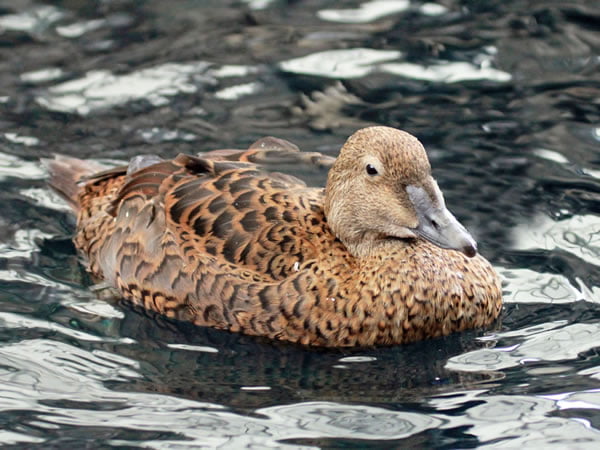
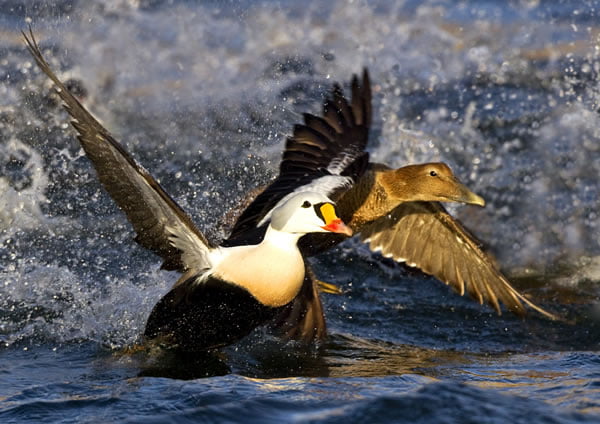
King Eider Photo Gallery
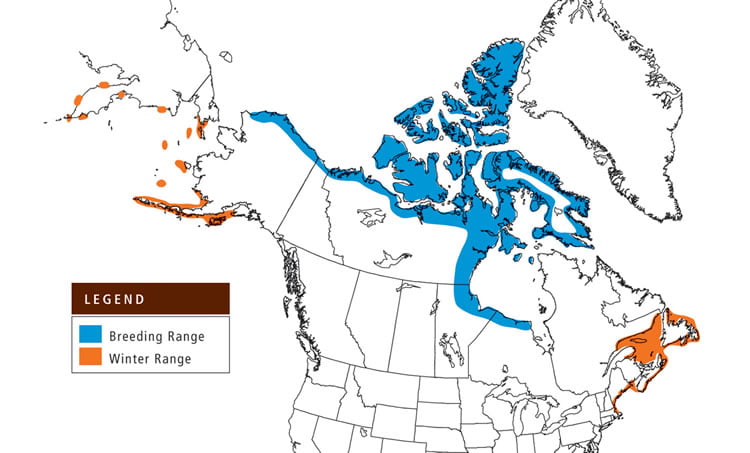
King Eider Range Map