Harlequin Duck
Histrionicus histrionicus
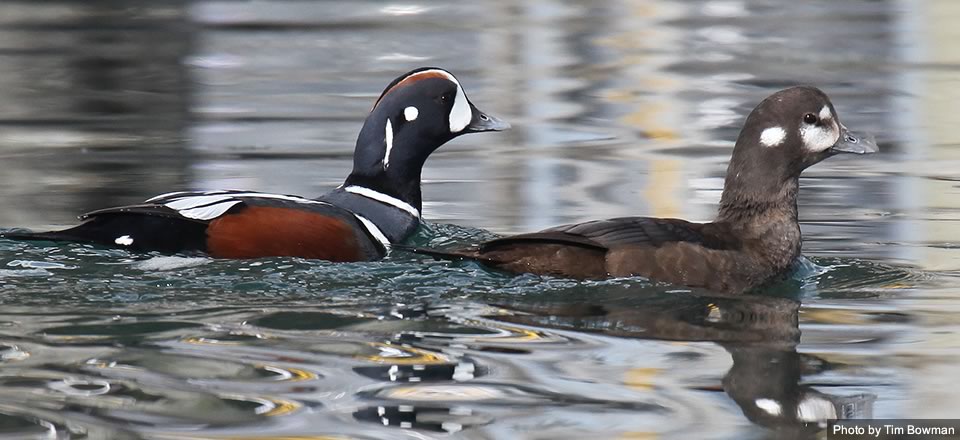
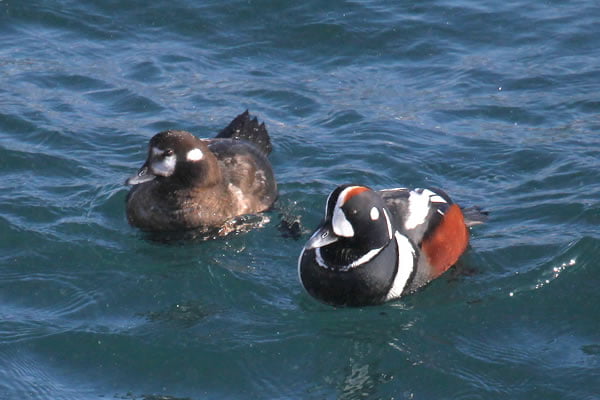
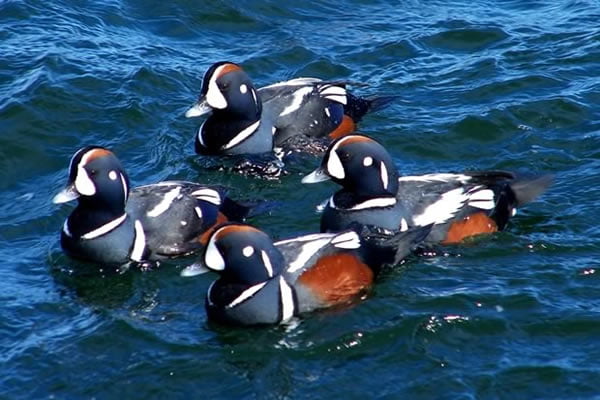
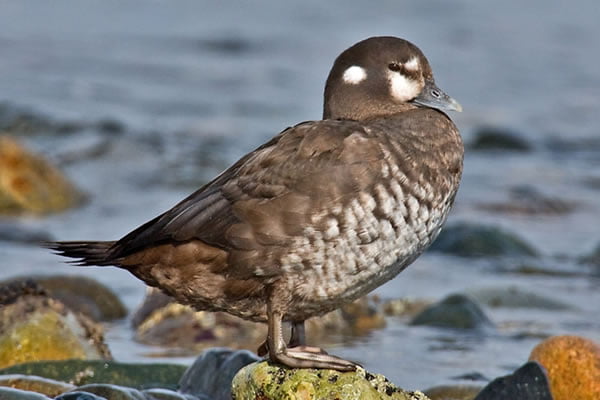
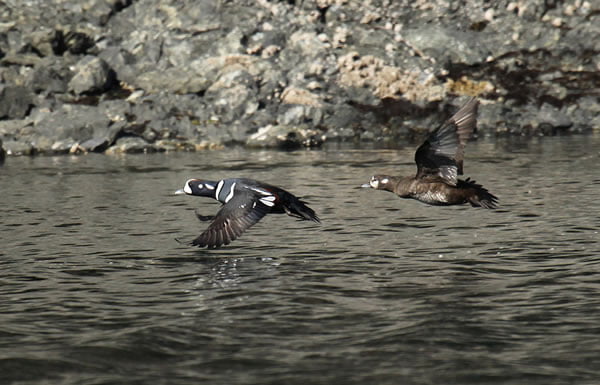
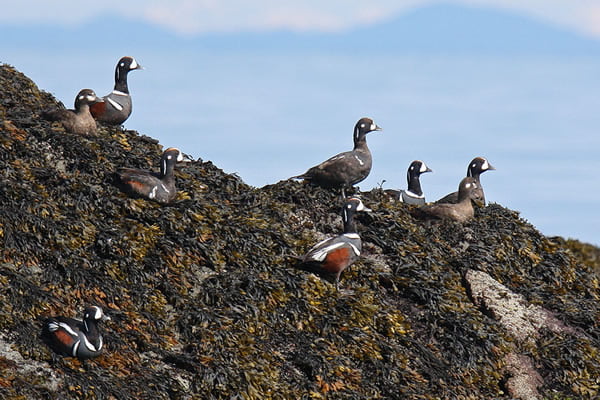
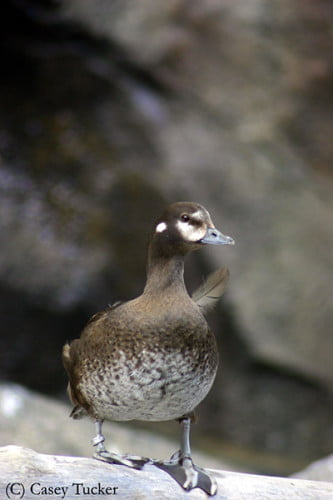
Harlequin ducks are small diving sea ducks. Males weigh about 650 g (1.4 lbs); females about 575 g (1.3 lbs). Males are striking, with a slate blue body, white bands and collars bordered by black lines on chest and neck, and a large crescent in front of the eye. They have a white spot behind eye and a white stripe along their neck. A black streak bordered by white and chestnut run along the top of the head, and the flanks are chestnut brown. Their wings are dark brown with an iridescent blue patch on the trailing inner edge and a few white spots or stripes close to the body.
Sea Duck Information Series fact sheet
Harlequin Duck Species Knowledge Summary and Information Needs [PDF]
Harlequin Duck Tracking Data
The Sea Duck Joint Venture has invested in numerous projects employing satellite and radio tracking devices to address pressing management-related questions. These data have enabled researchers to discover migratory pathways, delineate populations, and describe habitat use and behavior. This catalog includes existing tracking datasets for Harlequin Ducks.
[invisible]
SDJV Project 168: Characterization of the migratory patterns, connectivity, philopatry and timing of the western North American Harlequin Duck population throughout the annual cycle
Project Summary: Beginning in 2014, representatives from the Washington Department of Fish and Wildlife, the National Park Service, Montana Fish, Wildlife, and Parks, the Biodiversity Research Institute, Environment and Climate Change Canada, Bighorn Wildlife Technologies, and the Wyoming Game and Fish Department initiated a collaborative effort to tag Harlequin Duck with internal satellite transmitters. Researchers from Environment and Climate Change Canada conducted marine captures off the coast of British Columbia in 2014 and 2015; capture areas included White Rock, Hornby Island, and Kitimat. In addition, spring captures were conducted on breeding streams each year between 2016 and 2019 on the McLeod River in Alberta, in Glacier National Park and elsewhere throughout Northwest Montana, throughout the Cascade and Olympic Mountains of Washington, and in Grand Teton and Yellowstone National Parks, Wyoming. A small subset of historical telemetry data collected by the Alaska Department of Fish and Game from birds captured in Prince William Sound in 2001 and 2002 was also incorporated. In all, 113 male and 20 female Harlequin ducks were captured and implanted with PTT tags. Birds were tracked for varying degrees of time ranging from several weeks to just under 2 years. These data were brought together in a graduate project with objectives to describe habitat use, spatial patterns, and philopatry of western Harlequin Ducks.
Tracking Data: Some project metadata available in Movebank (ID 1451538847).
Related Publications: More information about the project, results and collaborators can be found on the SDJV Project 168 webpage.
Harlequin Duck Population Structure in Eastern Nearctic
Project Summary: A research team led by the Canadian Wildlife Service deployed 25 internal PTT satellite transmitters on Harlequin Ducks between 1996 and 1998. The research objectives were to determine whether distinct population segments existed among Harlequin Ducks in eastern North America and to determine relationships between breeding, moulting and wintering areas. 8 males were captured in Forillon National Park, Quebec in May 1998 and April 1997. 17 males were captured in eastern Hudson Bay, Ungava Bay and northern Labrador in June 1997 and 1998.
Tracking Data: More information coming soon.
Related Publications: Brodeur, S., J.-P.L. Savard, M. Robert, P. Laporte, P. Lamothe, R.D. Titman, S. Marchand, S. Gilliland, and G. Fitzgerald. 2002, Harlequin duck Histrionicus population structure in eastern Neartic. Journal of Avian Biology 33(2):127-137. doi.org/10.1034/j.1600-048X.2002.330202.x
Contact: More information coming soon.
New Insights on Harlequin Duck Population Structure in Eastern North America as Revealed by Satellite Telemetry
Project Summary: The purpose of this research was to delineate affiliations between breeding, molting, and staging areas of the Harlequin Duck population wintering in eastern North America. The research team captured 8 adult male Harlequin Ducks at Isle au Haut, Maine in April 2001 and surgically implanted them with Microwave PTT satellite transmitters. This research was led by the Canadian Wildlife Service.
Tracking Data: More information coming soon.
Related Publications: Robert, M., G.H. Mittelhauser, B. Jobin, G. Fitzgerald, and P. Lamothe. 2008. New insights on harlequin duck population structure in eastern North America as revealed by satellite telemetry. Waterbirds 31(sp2):159-172. doi.org/10.1675/1524-4695-31.sp2.159
Contact: More information coming soon.
Tracking Seasonal Movements of Adult Male Harlequin Ducks From Central Labrador Using Satellite Telemetry
Project Summary: This study aimed to determine migration patterns between breeding, staging, and molting areas of adult male Harlequin Ducks. The Canadian Wildlife Service captured 11 Harlequin Ducks between 2001 and 2002 and surgically implanted internal PTT satellite transmitters. All capture locations were in central Labrador.
Tracking Data: More information coming soon.
Related Publications: Chubbs, T.E., P.G. Trimper, G.W. Humphries, P.W. Thomas, L.T. Elson, and D.K. Laing. 2008. Tracking seasonal movements of adult male Harlequin Ducks from central Labrador using satellite telemetry. Waterbirds 31(sp2):173-182. doi.org/10.1675/1524-4695-31.sp2.173
Contact: More information coming soon.
Washington Department of Fish and Wildlife Harlequin Duck Tracking Data
Project Summary: The Washington Department of Fish and Wildlife tagged 19 Harlequin Ducks with satellite transmitters in Washington between 2016 and 2021.
Tracking Data: Metadata and contacts are available in Movebank (ID 170345563).
Related Publications: More information coming soon.
Wyoming Harlequin Duck Conservation Studies
Project Summary: Researchers from the Biodiversity Research Institute (BRI) conducted a study to track the migration and seasonal movements of breeding Harlequin Ducks. They visited breeding streams in Grand Teton National Park, Wyoming, to capture pairs and attach tracking technology between 2016 and 2018. They surgically implanted male Harlequin Ducks and attached small geolocator tracking devices to the leg bands of female Harlequin Ducks.
Tracking Data: More information coming soon.
Related Publications: More information is available on the BRI website and in the final project report.
Harlequin Duck Photo Gallery

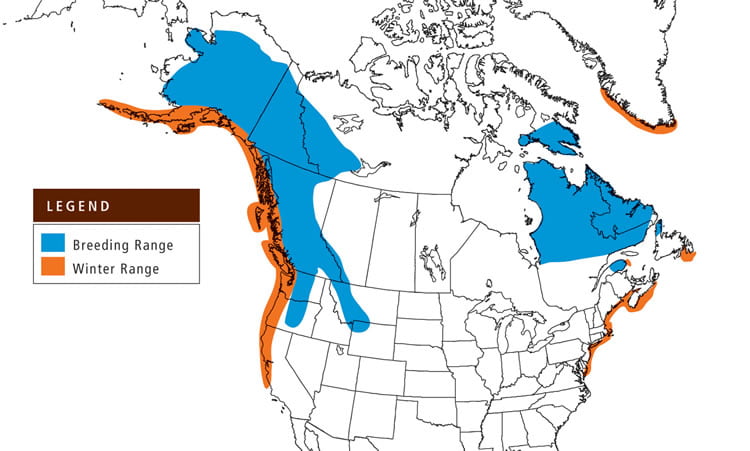
Harlequin Duck Range Map