
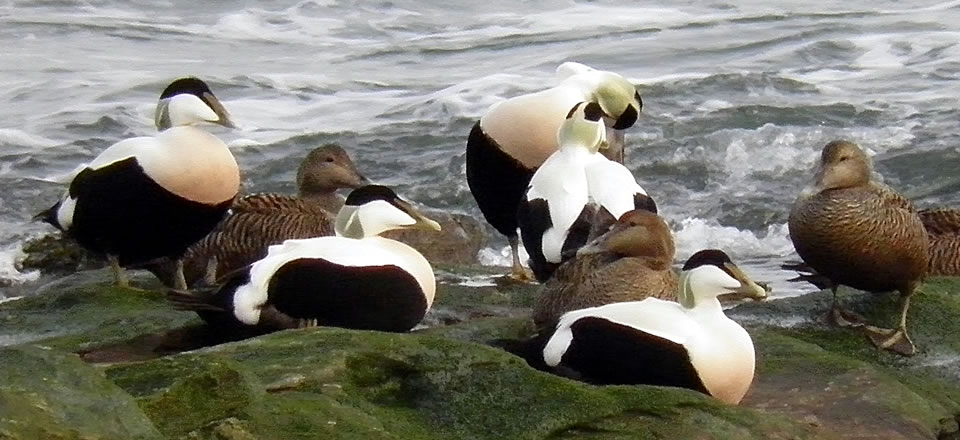
Common Eider
Somateria mollissima
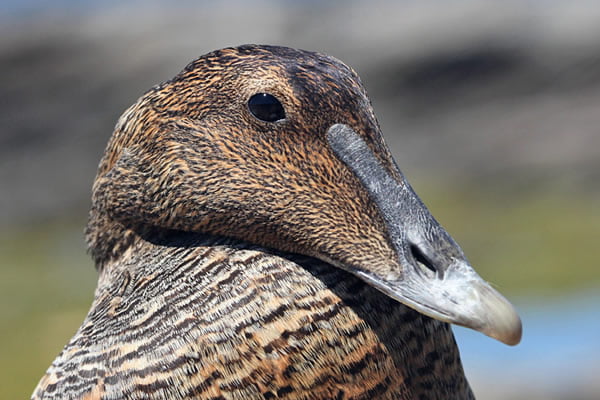
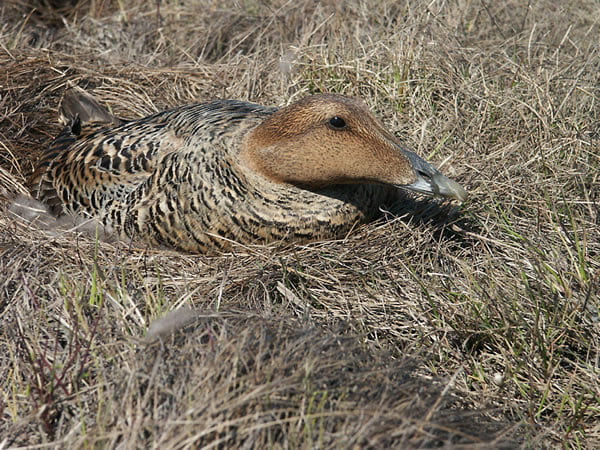
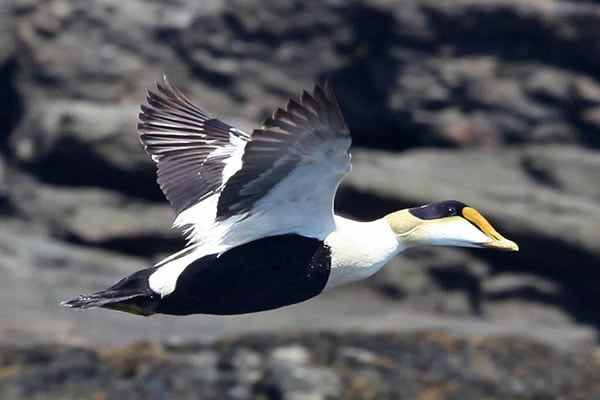
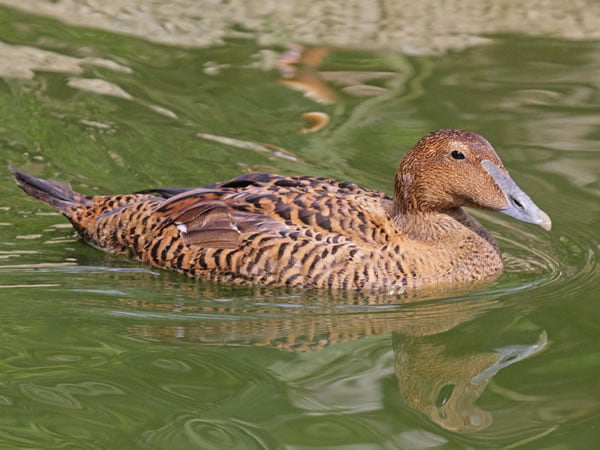
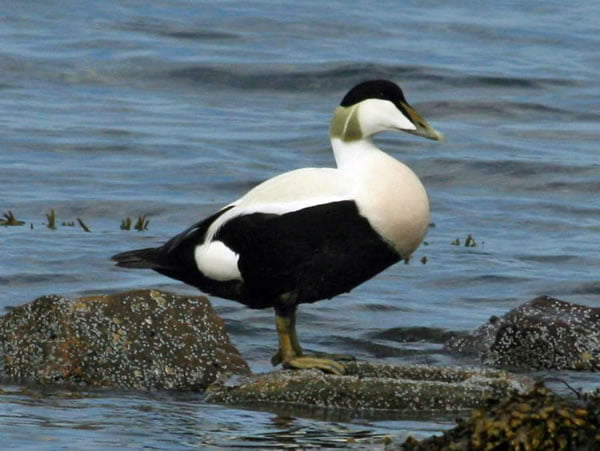
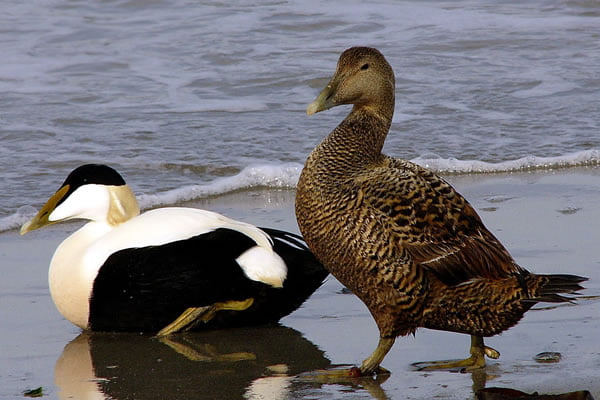
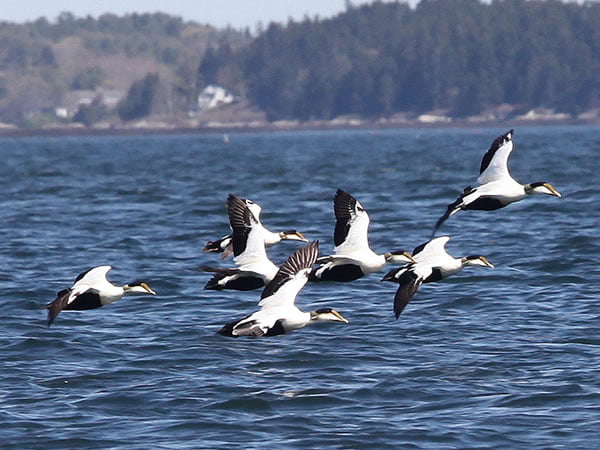
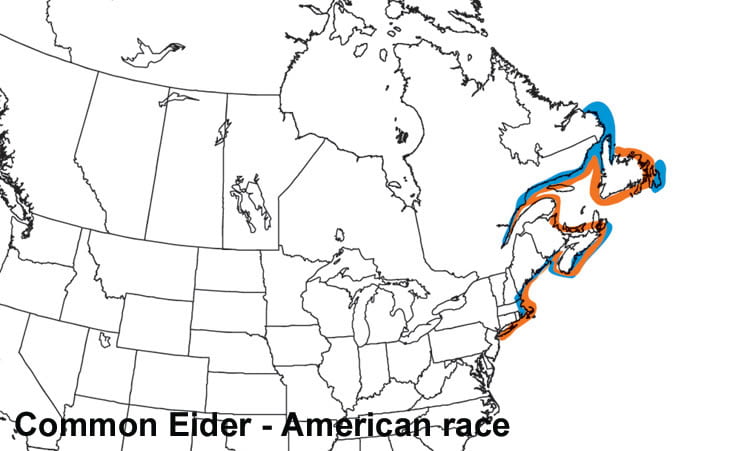
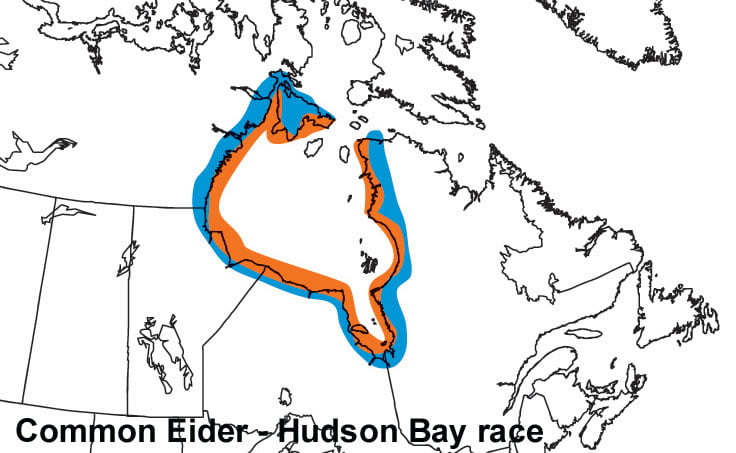
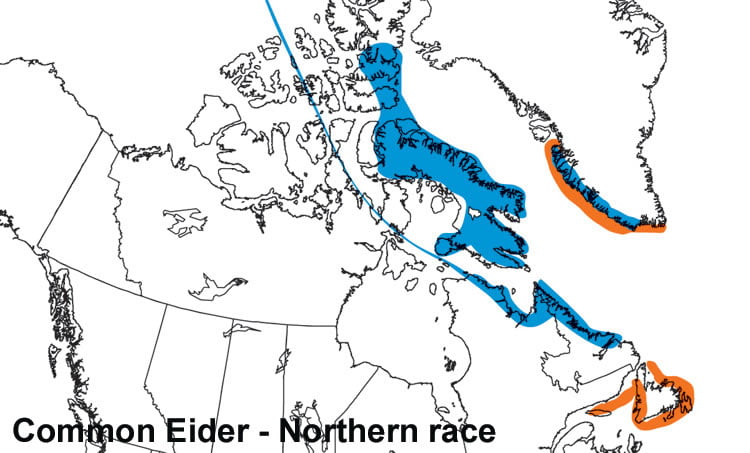
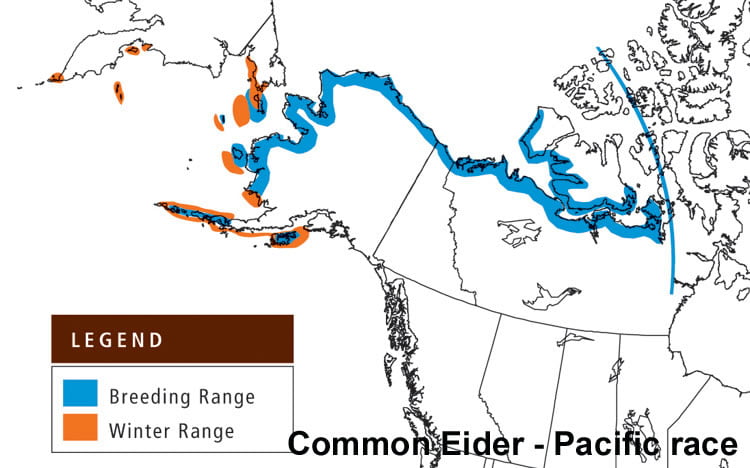
The Common Eider is the largest duck in the northern hemisphere; an adult weighs 1300–2660 grams (2.8–5.9 lbs) and is 50–71 cm (20–28 in.) long. Males are somewhat larger than females; size varies among races. The eider is a heavy-bodied sea duck with a relatively short, stout neck and a distinctive long, triangular (wedge-shaped) bill. There are four identified subspecies of Common Eider in North America.
Species Knowledge Summary and Information Needs
Common Eider Tracking Data
The Sea Duck Joint Venture has invested in numerous projects employing satellite and radio tracking devices to address pressing management-related questions. These data have enabled researchers to discover migratory pathways, delineate populations, and describe habitat use and behavior. This catalog includes existing tracking datasets for Common Eiders.
[invisible]
SDJV Project 162 — Identifying Demographic Bottlenecks and Habitat Use to Support the Recovery and Management of American Common Eider: A Range-wide, Full Life-cycle Telemetry Project
Project Summary: Between 2021 and 2024, researchers from 18 partner organizations surgically implanted 235 Argos PTT satellite transmitters in adult female eiders across their breeding range. Additionally, they deployed 68 Ornitela GSM-GPS transmitters in 2021. Partner organizations included Environment and Climate Change Canada, Canadian Wildlife Service, Ducks Unlimited Canada, Biodiversity Research Institute, the Maine Department of Inland Fish and Wildlife, Acadia University, the University of Quebec at Montreal, and the University of Windsor. Capture locations include Maine, Labrador, New Brunswick, Nova Scotia, and Québec. This project is currently ongoing.
Tracking Data: Data will be available in Movebank (ID 1489683415 for PTT transmitters and ID 1490219581 for GSM-GPS transmitters).
Related Publications: Visit the SDJV Project 162 webpage for reports and publications. This webpage is also available in French.
SDJV Project 91 — Movements of Common Eiders Breeding Along the North Shore of the Gulf of St Lawrence: Relationships Between Breeding, Molting, and Wintering Sites
Project Summary: A research team led by Jean-Pierre Savard of Environment and Climate Change Canada surgically implanted 10 common eiders with internal PTT satellite transmitters. The goal of this study was to understand whether the eiders of the St. Lawrence estuary and the Gulf of St. Lawrence interact in their population dynamics or overlap in their molting and wintering areas. Birds were captured and tagged between 2006 and 2007 in the St. Lawrence Estuary, Quebec. One male and nine females were captured with mist nets or with dip nets while on their nests.
Tracking Data: More information coming soon.
Related Publications: Visit the SDJV Project 91 webpage for related reports and publications.
Contact: More information coming soon.
SDJV Project 79 — Temporal and Geographic Distribution of the Aleutian Islands Pacific Common Eider: Rat, Andreanof and Near Islands
Project Summary: The objectives of this study were to locate and describe staging, molting, and wintering areas and describe key features of areas used by the Aleutian Islands population of Common Eider. The research team included the U.S. Geological Survey (USGS) and the U.S. Fish and Wildlife Service, with additional support from the U.S. Air Force. The researchers implanted 26 eiders with internal PTT satellite transmitters between 2006 and 2011. Capture locations were in the Near Island group of the Aleutian Islands in Alaska.
Tracking Data: The USGS Alaska Science Center has released tracking data for Common Eiders at https://doi.org/10.5066/P9JH3EXV. Additional data are available in Movebank (ID 62400821).
Related Publications: Visit the SDJV Project 79 webpage for reports and publications.
SDJV Project 23 — Characterization of Beaufort Sea Flyway: Long-tailed Ducks and Common Eider
Project Summary: This study used satellite telemetry to describe migration corridors and habitats used by Common Eiders that nest on barrier islands in the Beaufort Sea. The U.S. Geological Survey (USGS) surgically implanted 41 internal Microwave PTT transmitters in Common Eiders between 2006 and 2011. Capture locations included both the Beaufort Sea and the Yukon-Kuskokwim Delta in Alaska.
Tracking Data: The USGS Alaska Science Center has released tracking data for Common Eiders at https://doi.org/10.5066/P9JH3EXV. Additional tracking data are available in Movebank (ID 62400821).
Related Publications: Visit the SDJV Project 23 webpage for reports and publications.
SDJV Project 6 — Identifying Migration Routes and Wintering Areas of Common and King Eiders Breeding in Nunavut, Canada and Greenland
Project Summary: This satellite telemetry project aimed to identify King Eider and Common Eider breeding populations in Canada and Greenland that migrate to winter in southwest Greenland. 87 satellite transmitters were surgically implanted in Common Eiders between 2001 and 2003. Capture locations included East Bay in Nunavut and three locations in Greenland (Upernavik, Nuuk, and Disko Bay). This project was led by the Canadian Wildlife Service, with the Greenland Institute of Natural Resources and the National Environmental Research Institute of Denmark also participating.
Tracking Data: Datasets are available in Movebank (ID 8317873).
Related Publications: Visit the SDJV Project 6 webpage for reports and publications.
SDJV Project 2 — Identification of Beaufort Sea Migration Corridor for Sea Ducks
Project Summary: This study used satellite telemetry to study migration corridors for Common Eiders, King Eiders, and Long-tailed Ducks so that analysts could predict and mitigate adverse effects of offshore oil development in the Beaufort Sea. Between 2001 and 2003, the Canadian Wildlife Service used large mist nets to capture Common Eiders at a moulting location at Nauyak Lake, Nunavut. In 2006, additional Common Eiders were captured at Bathurst Inlet, Nunavut. A total of 70 eiders were surgically implanted with Microwave PTT transmitters.
Tracking Data: More information coming soon.
Related Publications: Visit the SDJV Project 2 webpage for reports and publications.
Contact: More information coming soon.
East Bay Island Migratory Bird Research
Project Summary: A research team deployed 48 satellite transmitters in Common Eiders and King Eiders between 2012–2013. This project was led by Grant Gilchrist and Christian Sonne at Environment and Climate Change with support from Baffinland Iron Mines. All capture locations were on East Bay Island in Nunavut. This tracking project aimed to investigate the influence of harvest, polar bear predation, avian disease, and industrial development on eiders.
Tracking Data: Metadata and contact information available in Movebank (ID 8560764).
Related Publications: More information coming soon.
Habitat Use and Movements of Common Eiders Wintering in Southern New England
Project summary: 24 adult female Common Eiders were captured during winter in southern New England in 2011/2012 and implanted with satellite transmitters. Objectives of the project were to quantify migratory phenology, home range size, fidelity and resource selection.
Tracking data: More information coming soon.
Related publications: Beuth, J.M., S.R. McWilliams, P.W.C. Paton, and J.E. Osenkowski. 2017. Habitat use and movements of common eiders wintering in southern New England. Journal of Wildlife Management 81(7):1276-1286. doi.org/10.1002/jwmg.21289
Molting, Staging, and Wintering Locations of Common Eiders Breeding in the Gyrfalcon Archipelago, Ungava Bay
Project summary: One male and 14 female common eiders were captured in June 2006 at nesting islands in Ungava Bay and implanted with satellite transmitters. Objectives were to identify the molting and wintering areas of birds breeding in Ungava Bay and to compare their home-range sizes during the pre-molt, molt, post-molt, and winter periods.
Tracking data: More information coming soon.
Related publications: Savard, J.-P.L., L. Lesage, S.G. Gilliland, G. Gilchrist, and J.-F. Giroux. 2011, Molting, staging, and wintering locations of common eiders breeding in the Gyrfalcon Archipelago, Ungava Bay. Arctic 64(2):197-206. https://doi.org/10.14430/arctic4099
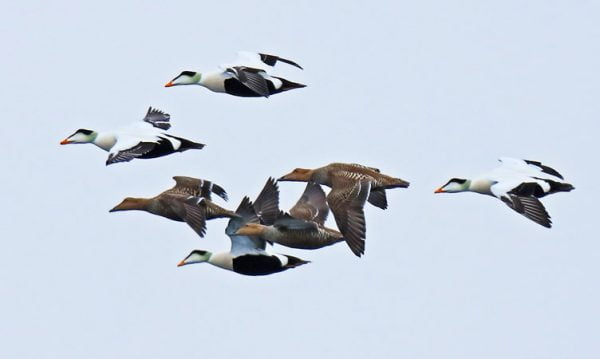
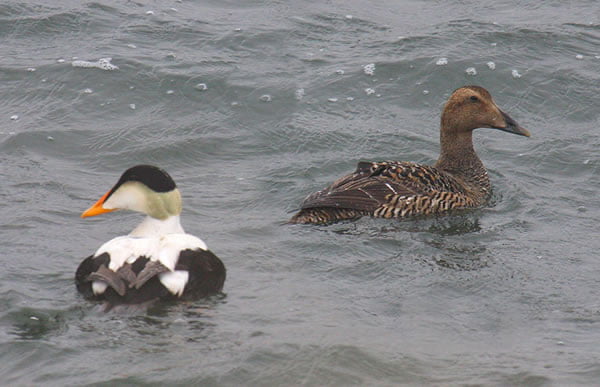
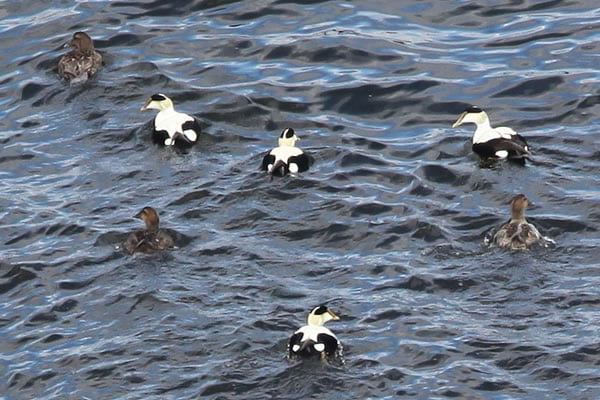
Common Eider Photo Gallery
Common Eider Range Maps
 |
 |
 |
 |
More Information, Publications, and Proceedings
Article about American Common Eider research – Dec 2021
American Common Eider Range-Wide, Full Annual Cycle Telemetry Project
Wellfleet Bay Virus Workshop (American Common Eider), June 2014 – abstracts (pdf)
Wellfleet Bay Virus Workshop (American Common Eider), October 2015 – abstracts (pdf)
Duvetnor – Common Eiders and eider down harvest in Quebec
Article about common eider satellite telemetry on Rhode Island coast