Barrow’s Goldeneye
Bucephala islandica
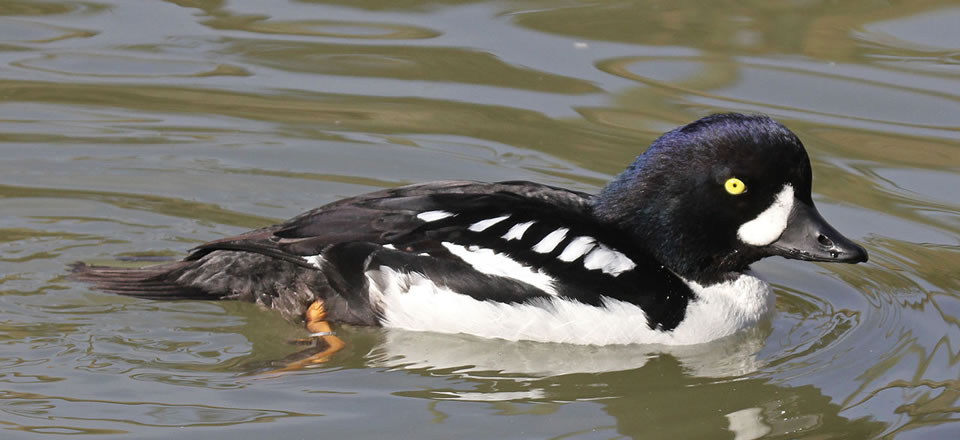
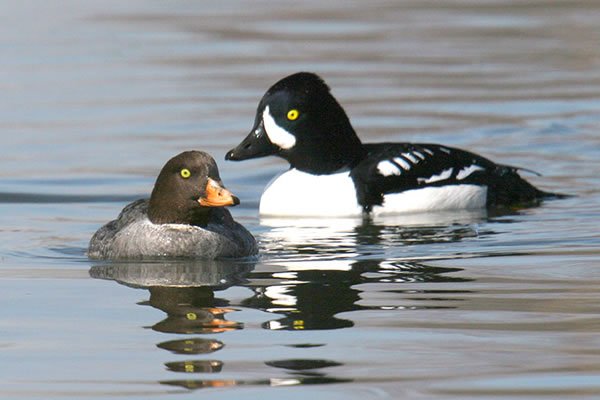
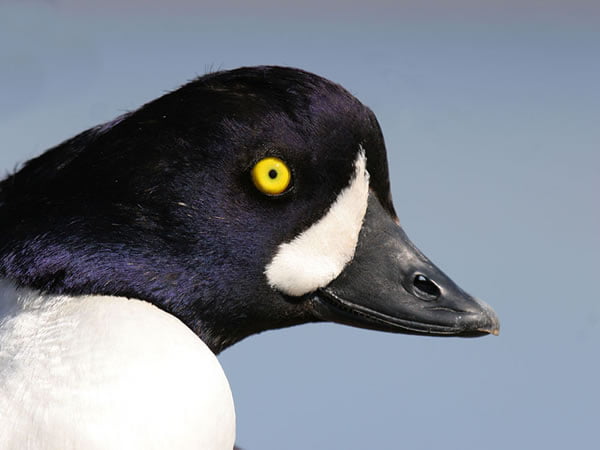
Barrow’s goldeneyes are chunky mid-sized sea ducks with short necks, a relatively large rounded head, and a short gray-black bill. Males are markedly larger than females; males are about 48 cm (19 in) and females about 43 cm (17 in). Spring weights for males average 1278 g (2.8 lbs.) and 818 g (1.8 lbs.) for females.
Sea Duck Information Series fact sheet
Barrow’s Goldeneye Tracking Data
The Sea Duck Joint Venture has invested in numerous projects employing satellite and radio tracking devices to address pressing management-related questions. These data have enabled researchers to discover migratory pathways, delineate populations, and describe habitat use and behavior. This catalog includes existing tracking datasets for Barrow’s Goldeneye.
[invisible]
SDJV Project 119 — Identification of Molting Locations of Adult Female Barrow’s Goldeneye in Eastern North America
Project Summary: In 2009, an Environment and Climate Change Canada research team captured five Barrow’s Goldeneye in Quebec and surgically implanted them with satellite transmitters. The goal of this study was to identify specific molting locations for Barrow’s Goldeneyes in eastern North America.
Tracking Data: More information coming soon.
Related Publications: For project reports and related publications, see SDJV Project 119 webpage.
Contact: More information coming soon.
SDJV Project 114 — Annual Cycle Connectivity, Inter- and Intra-annual Site Fidelity, and Habitat Use of Pacific Barrow’s Goldeneye
Project Summary: From 2006 to 2012, researchers surgically implanted 267 Barrow’s Goldeneyes with Microwave PTT satellite transmitters. at five sites in British Columbia, Alberta, and Alaska. This study was designed to quantify several important demographic attributes, including seasonal connectivity, site fidelity and dispersal rates. Capture locations included an important breeding site (Riske Creek, British Columbia), an important molting site (Cardinal Lake), and two wintering sites (Indian Arm, British Columbia and Prince William Sound, Alaska). This project was led by Environment and Climate Change Canada in collaboration with Simon Fraser University, the U.S. Fish and Wildlife Service, and Ducks Unlimited Canada.
Tracking Data: Metadata and contact information for data access can be found in Movebank (ID 1441422788).
Related Publications: Visit SDJV Project 114 webpage for reports and publications, as well as the webpages for similar studies SDJV Project 85 and SDJV Project 116.
Barrow’s Goldeneye Photo Gallery

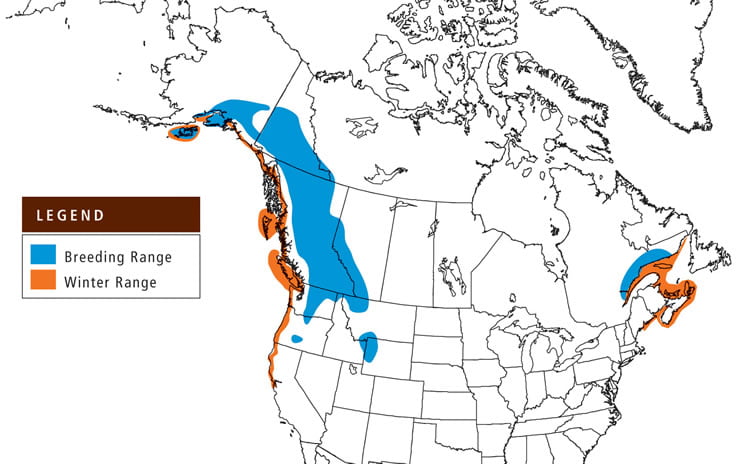
Barrow’s Goldeneye Range Map